Business Associations
From isolated efforts to a coordinated voices

At the start of the fellowship, the Antioch Chamber of Commerce was the only formal business association in a city of more than 115,000 residents. Many business and nonprofit leaders were unfamiliar with what associations could offer and assumed they needed to operate alone after decades of under-investment and the absence of a local economic development function.
This initiative set out to change that story by fostering collaboration among local businesses, nonprofits, and government, with the long-term goal of strengthening Antioch’s business climate and commercial corridors.
From Isolation to Collaboration
Historically, downtown merchants and other local leaders tried to organize but lacked governance expertise, resources, and technical assistance to succeed. The result was a pattern of individual efforts that rarely translated into durable structures.
Our approach focused on seeding collaboration where interest already existed and providing targeted support so that informal networks could evolve into sustainable associations over time. We shared accessible materials explaining what business associations are, promoted them at every opportunity, and used early conversations to identify sectors and neighborhoods with strong organizing potential.




Seeding Sector and Neighborhood Networks
Through the Antioch Business Collaborative (ABC), we supported early organizing efforts in specific industries and among nonprofits.
-
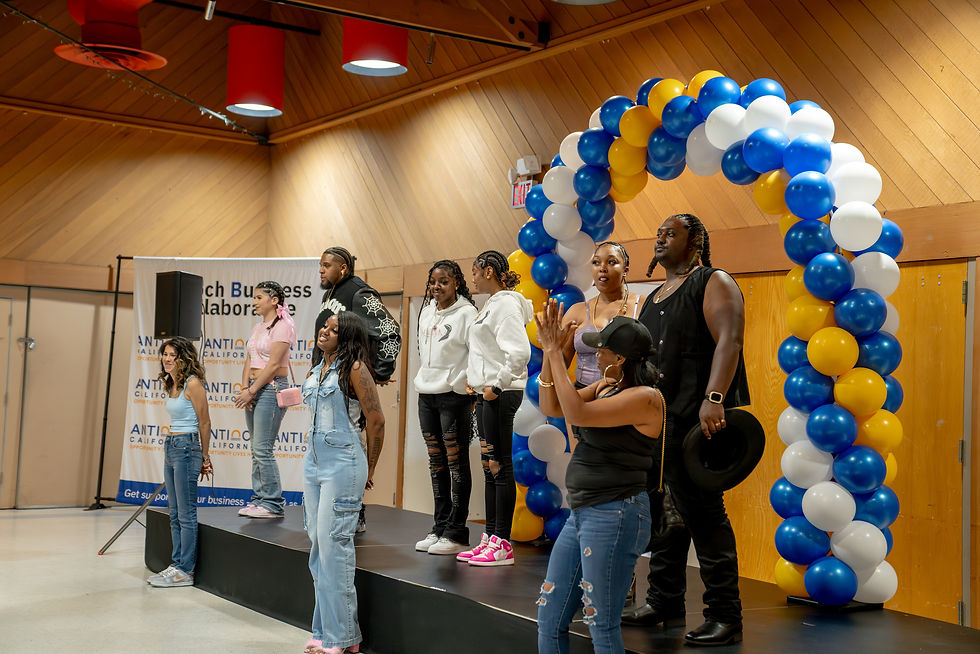
The Alliance for Community Development worked with beauty and wellness businesses, hosting events such as a Beauty Mixer and a Hair and Beauty Expo that helped owners connect, share information, and explore joint marketing.
-
Arroyo West focused on nonprofits, offering workshops, a public-facing Nonprofit Resource Fair, and cohort-based learning that strengthened relationships and coordination among local organizations.
While these groups have not formalized as associations, the relationships, shared events, and informal peer networks they created are important building blocks for future business and industry associations.
We also convened “techies and creatives” across sectors, leading to a resource‑sharing group and ultimately to the Antioch Made project, later funded through a national grant. Similar outreach connected arts and culture organizations with information about place-making and creative-economy opportunities and with technical assistance to pursue those opportunities.
Downtown Antioch Organizing
Downtown Antioch has been a focal point for association-building. Business leaders there have long recognized the value of organizing but lacked the structure and support to move from intention to implementation.
In response, the City initiated an inclusive request-for-proposals process to hire a consultant who would help merchants formalize a downtown association. Although funding for the consultant was ultimately redirected, the process itself brought merchants together, clarified shared goals, and sparked new momentum toward forming a Downtown Antioch Association.
Launching the Work Together Fund
To further catalyze collaboration, we secured a $20,000 Advancing Economic Mobility Rapid Grant from the National League of Cities, which pairs funding with technical assistance and peer learning for selected cities. The City used this support to launch the Work Together Fund, a grant program that incentivized partnership-based projects focused on job creation, economic mobility, and community infrastructure.
The program funded three cross-sector teams (nine organizations total):
Build Antioch ($7,910)
Capacity-building for a Downtown Antioch Association, including board development, a five-year strategic plan, and community engagement activities with arts, culture, and organizational development partners.
Antioch Made ($7,005)
A makerspace workforce pilot offering hands-on training in 3D printing, design, and marketing for local job seekers and creatives through a partnership among a makerspace, an environmental health firm, and an advertising agency.
Bloom Antioch ($5,085)
Financial skill-building workshops for entrepreneurs and residents, culminating in an Entrepreneur Fair led by three local small business owners.
The City designed and administered the entire process—from RFP and outreach through application review, contracting, and fund disbursement—and connected all applicants to technical assistance through Antioch Business Collaborative.

Lowering Barriers to Apply
The Work Together Fund used a traditional RFP structure but intentionally reduced common access barriers by:
-
Using a concise, structured application that focused on clarity and outcomes rather than jargon.
-
Promoting the opportunity through social media, trusted community partners, and existing business networks.
-
Hosting an informational session to explain the process and answer questions.
-
Offering free technical assistance to all applicants and awardees.
Coaching was provided through the Antioch Business Collaborative, whose advisors were briefed on the program’s goals and supported teams in shaping partnership-based proposals centered on economic mobility.
Applicants who used coaching were more likely to submit strong, fundable proposals that clearly articulated partnerships, roles, and implementation plans. All funded teams are continuing to use technical assistance during implementation.

Learning from External Support
As part of the national Advancing Economic Mobility Rapid Grant, we joined a cohort of other cities to receive technical assistance, peer learning, and strategic guidance on economic mobility from the National League of Cities. Convenings and regular cohort calls helped refine the program’s RFP, evaluation framework, and ecosystem strategy, while highlighting shared challenges and practical solutions.
Association with the National League of Cities also increased the credibility of the Work Together Fund and related efforts among internal departments, city leadership, and external partners. It signaled that collaborative, locally driven solutions are a priority and that Antioch is part of a broader movement to build equitable economic mobility.
Key Takeaways

Business associations and collaborative projects take time; seeding early networks and supporting them with technical assistance is essential.

Pairing flexible funding with coaching helps reduce barriers and improve proposal quality, especially for smaller organizations and first-time applicants.
_HEIC.png)
External partners can provide not only resources but also frameworks, peer examples, and legitimacy that strengthen local efforts.

Building toward formal associations is more successful when grounded in existing relationships and shared projects rather than created from scratch.